Welcome to Extea International Co., Ltd.′s official website!
- 86-571-89923671
- carrie.hong@extea.com.cn, hestings@vip.163.com

Welcome to Extea International Co., Ltd.′s official website!

As more consumers look for low-caffeine and wellness-focused beverages, decaffeinated tea has become one of the fastest-growing categories in the tea industry.
But not all decaf tea is produced the same way.
Different decaffeination technologies can significantly impact:
In this article, we'll explore how tea decaffeination has evolved over time and compare the three major methods used today.
The first commercial decaffeination technologies were developed in the early 1900s. Early manufacturers relied on chemical solvents to remove caffeine from tea and coffee.
As consumer awareness of food safety and natural ingredients increased, the industry began exploring alternative methods that could better preserve flavor while reducing chemical usage.
Today, three main approaches dominate the market:
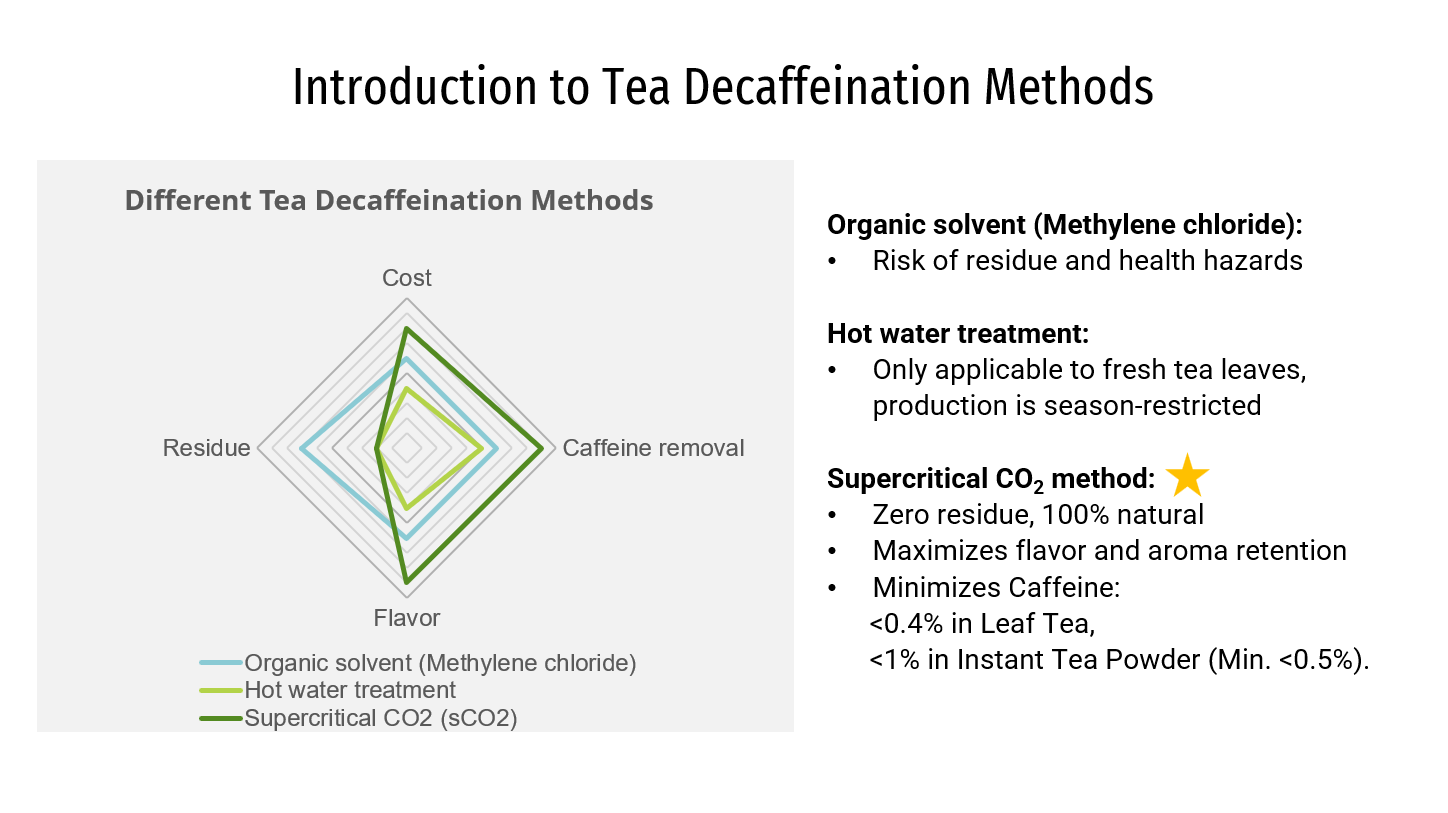
Each method offers different advantages and challenges.
How It Works
Tea leaves are first moistened or steamed.
A food-grade solvent—typically methylene chloride or ethyl acetate—is then used to selectively dissolve caffeine. After extraction, the solvent is removed and the tea is dried.
Main Equipment
Advantages
✓ Relatively low production cost
✓ High caffeine removal efficiency
✓ Suitable for large-scale manufacturing
✓ Established and widely used technology
Disadvantages
✗ Consumer concerns about chemical processing
✗ Potential trace solvent residues (within regulatory limits)
✗ Some loss of flavor and aroma compounds
✗ Less attractive for clean-label products
How It Works
Tea leaves are soaked in water, allowing caffeine and other soluble compounds to dissolve.
The liquid is then filtered through activated carbon systems that remove caffeine before the water is reused.
Main Equipment
Advantages
✓ No chemical solvents
✓ Strong consumer acceptance
✓ Natural processing image
Disadvantages
✗ Water removes flavor compounds along with caffeine
✗ Reduced aroma and taste complexity
✗ High water consumption
✗ Less commonly used for premium tea products
How It Works
Carbon dioxide becomes "supercritical" when exposed to high temperature and pressure.
In this state, CO₂ behaves like both a gas and a liquid. It can penetrate tea leaves efficiently and selectively extract caffeine while leaving many desirable flavor compounds behind.
After extraction, the caffeine is separated and the CO₂ is recycled for future use.
Main Equipment
Advantages
✓ No solvent residue
✓ Excellent flavor retention
✓ Preserves natural tea aroma
✓ Environmentally friendly CO₂ recycling
✓ Premium-quality final product
Disadvantages
✗ Higher equipment investment
✗ More complex operation
✗ Higher production cost
|
Criteria |
Organic Solvent |
Water Process |
Supercritical CO₂ |
|
Production Cost |
Low |
Medium |
High |
|
Caffeine Removal |
High |
High |
High |
|
Flavor Retention |
Moderate |
Moderate |
Excellent |
|
Chemical Residue Risk |
Low but possible |
None |
None |
|
Consumer Perception |
Mixed |
Positive |
Very Positive |
|
Sustainability |
Moderate |
High water use |
CO₂ recyclable |
|
Equipment Investment |
Low |
Medium |
High |
|
Premium Tea Applications |
Limited |
Moderate |
Excellent |
Today's consumers want more than just low caffeine.
They also expect:
Among currently available technologies, Supercritical CO₂ decaffeination offers one of the best balances between caffeine reduction and flavor preservation.
This is why many premium tea brands, specialty beverage manufacturers, and functional tea producers increasingly choose this technology for their decaf tea products.
We offer a complete range of Supercritical CO₂ Decaffeinated Tea ingredients, including:
Products
Custom Solutions
- Beverage applications
- Functional products
- Private-label tea brands
- Customized ingredient development
Whether you are developing ready-to-drink beverages, tea concentrates, supplements, or specialty tea products, our team can help you find the right decaf tea solution.